OSHA sanitation rule 1926.51 requires at least one toilet on a job site for up to 20 workers, with a second unit added past 20 and a further unit for every additional 40 workers. A crew of 45 framers in Slavic Village…
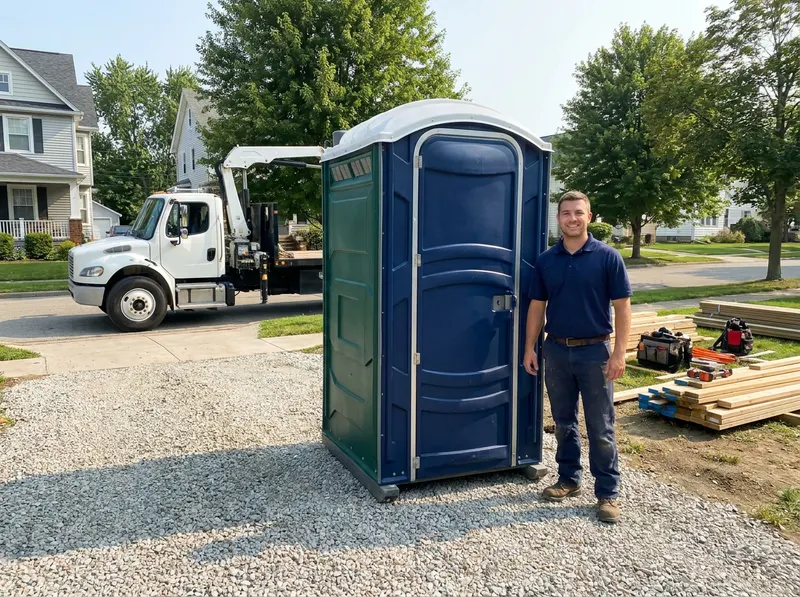
OSHA sanitation rule 1926.51 requires at least one toilet on a job site for up to 20 workers, with a second unit added past 20 and a further unit for every additional 40 workers. A crew of 45 framers in Slavic Village therefore needs 3 units on site, not one, undersizing is the most common compliance gap on Cleveland builds. Cuyahoga Portable Toilet Rental sizes the unit count to the crew count at the quote stage so the site starts compliant on day one.
Standard construction units are the workhorse: a molded polyethylene enclosure roughly 44 inches square and 90 inches tall, with a 60-gallon holding tank that supports about 10 workers for a full week between services. Flushing units add a foot-pump flush and a small freshwater sink, which suits longer builds in University Circle or finished-trade phases where crews want handwashing on hand. ADA-compliant units run about 5 feet wide with a ground-level entry and interior grab bars, required when the site plan or a public-facing project calls for accessible facilities. A handwash station or holding tank can be added alongside any unit.
Decision fit follows the job. A short excavation or a two-week roof tear-off in Old Brooklyn is served fine by a single standard unit on the $250 monthly minimum. A multi-month general-contract build in Detroit-Shoreway with 30-plus tradespeople warrants multiple units plus a handwash station, serviced weekly so tanks never overflow mid-cycle. Tight infill lots in Tremont and Ohio City are the recurring placement challenge: units set on a stable, level pad within about 40 feet of the truck's hose reach, since a service truck cannot pull a hose across an entire site. Sharing the intended placement point when booking prevents a redelivery trip.
Servicing is where a construction rental differs from a one-day event drop. Units on active sites in Collinwood, Glenville, Buckeye-Shaker, and Kamm's Corners are placed on a fixed weekly route, a technician pumps the tank, sanitizes the interior, and restocks toilet paper on the same day each week for the length of the rental. A single standard unit is rated for roughly 10 workers per week; heavier headcounts move to twice-weekly service to stay ahead of the tank. Frozen ground and snow across a Cleveland winter build are planned into the route rather than treated as an exception.
How it works is four steps. First, call (216) 682-2776 or text a site photo with the address, crew size, and start date. Second, the unit count and type are sized to the crew and a delivery window is confirmed. Third, units are placed on the agreed pad and the weekly service route begins. Fourth, at the end of the rental the units are pumped a final time and hauled off. A portable restroom rental is not a permanent hookup, no plumbing, water line, or electrical connection is involved, and no permit is needed on private job-site property in most of Cuyahoga County. Placement in a public right-of-way or on a closed street lane can require a city permit, which the site's general contractor typically pulls.
Every job gets a firm, written price after a free on-site visit.
Tell us about your construction site toilet rental job in Cleveland and we'll send a clear, written quote, usually the same day.
 Cuyahoga Portable Toilet Rental